Showing posts with label TIME MANAGEMENT. Show all posts

Monday, June 30, 2014

10 Ways You Can Bend Time to Improve Your Life


TIME

Fact: Every day, we all start with 24 hours. Subtract the recommended 7 to 9 hours of sleep, and we're left with a measly 15 to 17 waking hours per day. No wonder we're always rushing around, trying to cram in all our "have-tos" and "want-tos!" But sometimes slowwwwwing down to enjoy the good stuff — and speeding up to increase efficiencies in other areas — can add a whole lot of awesomeness to everyday life.

1. Truly Enjoy Those Things Worth Savoring

Think of one or two things that you look forward to every day. Whether it's sitting outside watching the birds fly around the bird feeder, walking the dog, or enjoying an after-dinner cocktail, see if you can find an extra 10-15 minutes to really savor the experience.
For me, there never seems to be enough time between the blaring of the alarm clock and the rush out the door in the morning. I used to blast through my morning routine on high-speed auto-pilot — so quickly that before I knew it, my coffee pot was empty, and I could hardly remember drinking it. But one weekend morning, when I was leisurely enjoying my morning java, I had a coffee epiphany: Wow… this tastes amazing! It was a life-changing moment. By waking up 15 minutes earlier, I now slow down and appreciate its deliciousness sip by sip — every day!

2. Do It Right the First Time

When you slow down, whether it's at work, in the kitchen, or during an argument with your partner, you reduce your chances of making mistakes. How awesome is the thought of not needing to cover a bank overdraft, run out for fast food when you scorch the chicken, or find ways to tell your honey that you really, really did not mean those things that just slipped out of your mouth before thinking? One of my favorite John Wooden quotes sums it up best: "If you don't have time to do it right, when will you have time to do it over?" Mistakes happen, but more often than not, it's because we're rushing. Instead, slow down and do it right the first time.

3. Be Present

It's impossible to multitask and be 100% present at the same time. Sure, you can drive the car and listen to the radio — even sing along to your favorite song — but you can't really focus on your partner's detailed account of a problem at work while scrolling through your Twitter feed.
Make an effort to decide what things will get your full and undivided attention. Sometimes full presence trumps efficiency.

4. Multitask Smartly

Many low-attention items on your to-do list can be grouped together to spend your time more efficiently. For example, why not fold a load of towels while catching up on the latest episode of Orange is the New Black? Catch up on Facebook while on hold with the cable company. Often, we find ourselves multitasking haphazardly, which can cause problems. But purposeful — scheduled — multitasking often makes sense. 

5. Delay Purchase, Increase Satisfaction

You just saw the cutest purse / coolest pair of sunglasses / latest and greatest iPhone… Sure, impulse gifts-to-self can be fun, but anticipated purchases can be far more gratifying. Keep a little "wish list" going, and reward yourself with a special purchase when you reach a goal.
When you make a decision to buy that certain something that you really want, schedule it for a later time (even later that same day), another day, or as a reward after you finish that daunting task that's been on your list for months.
Anticipating the purchase will make it that much more enjoyable once it becomes yours.

6. Spend Less Time on Workouts for Better Results

Interval training, combining short bursts of high-intensity activity with intervals of slower, lighter intensity activity can help burn more calories, improve your aerobic capacity, and keep your workouts from becoming boring. Add a few sprints to your bike ride, jog or walk — and notice results faster.
When lifting weights, super slow reps can improve your strength by creating greater tension and recruiting higher muscle fiber, according to Dr. Len Kravitz of the University of New Mexico. While not all experts agree that super slow weight lifting indeed creates stronger muscles, scripted group exercise classes like Group Power and Group Rideincorporate varying speeds and counts in all of their exercise routines.

7. Read for Speed and Boost Comprehension

Think about all the reading you do on an average day. Newspapers (online or in print), emails, reports, proposals, notes from school… On average, people read about 250 words per minute, according to Mindtools. Did you know that — in addition to helping you read faster — speed reading can also improve your comprehension of the "big picture" message of the content? Sometimes getting the gist of a newspaper article is good enough, and wasting time on the impertinent details can get you backlogged.
Other times, of course, reading slowly — paying close attention to every word — is necessary. Missing or misreading one word in a contract or proposal can have disastrous implications! When reading for pleasure, going slowly allows you to appreciate the details of the images the author has painted with words.

8. Shop Fast and Save Money

Wouldn't it be great to come home from the grocery store without buyer's remorse — or tempting diet sabotages? Schedule your grocery shopping as you would for other activities on your "to-do" list, allotting a reasonable time limit — and sticking to it. When you grocery shop with a list in hand and a predetermined time span, you can dash up and down the aisles, grabbing the items that you need, and avoiding the temptations that may lurk in the junk food section. Go quickly, stay focused and get it done! (But remember to smile at the cashier, the "rush" ends when you hit the check-out lane.)

9. Make Time for the Important Stuff

Sometimes we get too busy to meet a friend for lunch or a beer after work. Even finding time to chat on the phone often takes a back seat to appointments, work deadlines, carpools, and other obligations. But as much as we sometimes tell ourselves we can't afford the time, the truth is, we can't afford not to take the time to connect with friends. Few things nourish the soul like a good, old-fashioned gab session with a friend.
Making time to rest, finding "me-time" to recharge, or even indulging in healthy routines like exercise are all things we know we should do for ourselves, yet they often take a backseat, thinking they can wait another week. They can't. Give the same priority to relationships and self-care as you do to checking your email and social media — the things that often can wait another week.
Rather than feeling as if we don't "have enough time," realize that the way we spend our time is up to us.

10. Make "a Long Time" More Manageable

No matter how you slice it, an hour is 60 minutes, a week is 7 days, and so on. But all time does not feel equal. Somehow, an hour in the dentist's chair simply doesn't pass as quickly as an hour of Zumba. Long periods of time can be toughest, whether it's undergoing treatment for a serious illness, recovering from a broken leg, or waiting for a family member to return from military duty in Afghanistan, time can feel often feel like a jail sentence. Even anticipating the good stuff — taking that well-deserved beachy vacation or remodeling your kitchen — can seem to last for an eternity.
One strategy to conquer the "mountain" of time is to break it into manageable chunks, marked by smaller milestones. Choose an activity to help you mark time; for example, try one new recipe per week while awaiting your spouse's return from military duty; at the end of the wait, you'll have your partner back — and all kinds of new meals to put on the table!
Instead of letting yourself become overwhelmed by what may feel like an abyss of time, manage what feels manageable — whether it's a day, a week, or a physical therapy session at a time.
Source:10 Ways You Can Bend Time to Improve Your Life

Tuesday, May 27, 2014

Time, Money, Productivity, and Life


Productivity is never an accident. It is always the result of a commitment to excellence, intelligent planning, and focused effort.
Paul J. Meyer
Do you feel guilty when you’re not doing something productive? In this age of time management, we can easily adapt the idea that if we are not being productive then we are wasting time. So we try to get super organized in an effort to be more productive.
We could claim our attempts to cram as much as possible into each day is based on the fact that life is short and we want to accomplish all we can. I’m sorry, but that argument just doesn’t hold water. Why? For one thing, it’s our natural tendency to seek out ways to enjoy ourselves, not to push ourselves to the limit.

How do you define time?

How we view the whole concept of time has a powerful influence on our priorities. If we buy into the “Time is money” approach introduced by Benjamin Franklin, then productivity becomes our first priority.
We all recognize that Ben Franklin was a smart guy, but when he said time is money I don’t think he was suggesting that we build our lives around that concept. By the way, he also said that “Credit is money” and we can all see the result of building an economy around that precept.

Putting a price on time

When we accept the idea that time is money we are essentially assigning a monetary value to time. How does that affect our perspective of life? It causes us (and others) to base our worth on how productive we are and how much we earn. This is a devastating point of view for several reasons. Let’s consider a few:
Fallacy #1. If I earn $50 per hour and you earn $500, then I must be worth 90% less than you are. If I accept this premise, then I will probably develop some limiting beliefs about my worth as a person. If you agree with this value scale, then you will begin to think of yourself as superior. Both of these points of view are damaging.
Fallacy #2. A highly paid professional who earns a fortune pumping deadly toxins into the environment will be viewed as more valuable than a dedicated teacher who incites his students to reach for their dreams while maintaining personal integrity. This “time is money” perspective would also place the loving, nurturing mother who gave up her career to take care of her family, on the bottom of the value scale.
Fallacy #3. The working person willingly sacrifices family time for a chance to raise his income because, in doing so, he thinks he will increase his worth as a husband and father. When he comes home too late to see his children in the evening he will sincerely explain, “I’m doing it for you.”

If time is not money then what is it?

In a sense, Ben Franklin had it right when he associated time with currency; he just chose the wrong one. You see, the value of money is tiny compared to the value of time, even though making a living does require that we spend some of our valuable time in that pursuit.
When we spend our valuable time we should view it as something that far exceeds the worth of money. Yes, it takes a certain amount of money to care for our material needs and wants, but that is just one, small aspect of life. And this brings us to the real point of this article.

Time is the currency of life

Some will argue that time is a concept created by man and that it really doesn’t exist. All I can say to that is – what happens to your life when you run out of time? See my point? We only have so much of this valuable commodity and when it’s gone all the money in the world can’t buy you more.
Here’s where a proper view of productivity can help. If our level of productivity allows us to care for our material needs while only spending half as much time doing so, then from a practical standpoint, we have actually gained a lot of time for other pursuits. In fact, isn’t that what’s behind the intellectual draw toward increased productivity? In a nutshell, more money in less time means more time doing what we want.

Keep your balance and avoid the traps

The real challenge here is to use increased productivity in a balanced way so we reap the benefits and avoid the pitfalls. Creating greater earning potential so we can spend more time doing other things will likely require a period of focus and dedication. Once our efforts begin to pay off we need to avoid the following traps.
* Getting obsessed with earning more, more, and still more.
* Allowing super productivity to become an obsession.
* Forgetting why we chose this course to begin with.
* Slipping into the time is money mindset.
* Enslaving ourselves by continually increasing our spending.
* Thinking that more income changes our worth as a person.
* Endlessly trading the currency of life for mere money.

A synergistic approach

In life, there is either synergy, or there is conflict. The secret to avoiding conflict is to harmonize life’s many aspects so that they exist in a balanced and synergistic relationship with one another. What is required to maintain that sense of harmonious balance?
We need to keep the big picture in view and not allow ourselves to become hypnotized by the seductive lure of money. Our precious time is the real commodity of life. Recognizing its immense value will help us to spend it wisely.

Friday, July 29, 2011

Be Effective in Time Management


Effective timw management


Until we can manage TIME, we can manage nothing else. ~ Peter F. Drucker


The meaning of time management


Time management is self-management. It is to fill the time and do the things that matter the most to you. The most important thing is to enjoy what you do. Life is challenging and yet it is satisfying. When you like what you do every day, you will look forward to each new day hopefully and enthusiastically.


The way to manage time

If you want to make good use of your time, you've got to know what's most important and then give it all you've got. ~ Lee Iacocca


In order to spend time wisely, usefully, and productively, you have to organize and plan ahead and get things done promptly as planned. When you delay or procrastinate, it will take you a long time to reach your goals or get things done.


What do you want to accomplish?

Many people seem to think that success in one area can compensate for failure in other areas. But can it really?… True effectiveness requires balance. ~ Stephen Covey


The ultimate aim of time management is to achieve a balanced life. It means you are able to allocate your time to take care of many indispensable areas of your life. You cannot overlook the importance of each one. Your success in time management is to show how capable you are in spending your time to cover these areas and live a balanced life. Do you think you have spent enough time in the following areas?


• Work: When you enjoy what you do to earn a living, it is no longer work. If you don’t, you have to find happiness at work because you are going to spend more than 8 hours a day at the workplace. It is essential to like what you do while you spend time at work. To work is to earn an income to support your family and do everything else.


• Play: You work hard and you also need to play hard. To play is to exercise and to regain your balance after a stressful day at work.

Investing time to be physically fit is an important part of time management.


• Rest: To rest is to take breaks while at work. Your performance diminishes when you work non-stop. You are not wasting time when you take a break.


• Family: This is a crucial area to invest your time. Your family is at the centre of your life. You have to spend time to communicate, interact and have fun together.


• Reading and learning: It may not be urgent, but you still need to allocate time to read, learn and update yourself in order to stay ahead in this competitive world.


• Thinking: Spending some time in the evening to review your performance is time well-spent. Are you happy with what you have done for the day? Did you manage to complete the tasks on your to-do list? It is also a good time to plan ahead and get organized for the following day.


• Relationship building: We are all connected. We share, exchange, give and we receive in return. It is mutually beneficial to spend time and be connected with those we care for.


• Personal finance: If you don’t spend time to work out a budget and live within your means, you will regret later with unmanageable debt. You have to spend time and review your spending and save for your children’s education and your retirement.

At the end of the day, you will be happy that you have spent time doing what is worthwhile and fulfilling. When you do, you have, effectively, lived a day with contentment.

We must use time wisely and forever realize that the time is always ripe to do right. ~ Nelson Mandela

There is never enough time to do everything, but there is always enough time to do the most important thing. ~ Brian Tracy

Friday, May 20, 2011

14 Ways to Waste Your Time

Waste  no time


Lost wealth may be replaced by industry, lost knowledge by study, lost health by temperance or medicine, but lost time is gone forever.
Samuel Smiles

A man who dares to waste one hour of life has not discovered the value of life.
Charles Darwin

There are many ways to waste time without you noticing it. You think you are busy but you are not spending time effectively:

  1. Do what is less important first: Do not waste your time and energy doing unimportant tasks when you are at your peak performance. Do what is important and difficult when you are able to concentrate to perform your best.   

If you want to make good use of your time, you’ve got to know what’s most important and then give it all you’ve got.
Lee Iacocca

  1. Never plan ahead: If you don’t spend a little time planning ahead you are wasting more time doing the wrong things and left out what is important.  Get ready a   to-do list for the day, schedule tasks according to priorities, and get things done accordingly and smoothly.

  1. Never delegate: Don’t do it yourself when others can do the job for you, It is the best way to get more done in less time. Do not be afraid to delegate. Trust others to do a job well.

  1. Getting interrupted and distracted: Avoid getting disturbed when you need full concentration for a block of time to get things done.

  1. Unnecessary meeting: Ty to communicate by other means instead of a meeting. More time can be wasted when the meeting is off topics and out of the agenda.

  1. Socializing too much with co-workers: Taking a short break from time to time is good but taking too long a time to chat with co-workers is unproductive.

  1. Rushing: It is a bad habit to rush about and get things done. You are more likely to make mistakes and need to do it all over again and waste valuable time.

  1. Do not clarify: The worst thing to do when you are in doubt is to do guesswork.
Get clarification and do it right for the first time. Do not be ashamed to ask.

  1. Do not write things down: Every time when you need to remember something it is more effective to write it down like taking a telephone message. Don’t waste your time and try to recall from your memory what the message is all about.

  1. Clutter desk: A messy desk disturbs your peace of mind and hinders you from working undistracted. It is also a waste of time looking for things in a pile of paper.    

  1. Haphazard filing system: Like a cluttered desk, a document not properly filed is as good as lost. It is also a waste of time trying in vain to retrieve it.

  1. Procrastination: There will never be a better time to do anything, now is the time to do what is right. Do it now and get into the process of doing it. Before you know a job is done and you are happy about it.  

The time for action is now. It’s never too late to do something.
Carl Sandburg

  1. While waiting do nothing:  When you are expected to wait, be prepared to do something useful and the best thing to do is to read and enrich yourself. Do carry a book or a magazine while waiting for your turn to see someone in the office.

Whether it’s the best of times or the worst of times, it’s the only time we’ve got.
Art Buchwald

  1. Overcommitted: Do not say yes too often too soon. Your time is limited; promise to do what is important when time permits. Do not overwhelm yourself and get into a stressful situation.   


How you spend your time is more important than how you spend your money. Money mistakes can be corrected, but time is gone forever.
David Norris.


Saturday, April 30, 2011

Are You Managing Your Time Effectively?

Time


We must use time wisely and forever realize that the time is always ripe to do right. ~
 Nelson Mandela

Time = life; therefore, waste your time and waste of your life, or master your time and master your life. ~ Alan Lakein


  1. Never spend time to manage time: If you don’t organize your day, you may get nothing done or busy doing something but nothing important gets done. Plan ahead and prepare a to-do list for the following day so that it will be a productive and meaningful day every day,

  1. Refuse to get up in the morning: It is a sign that there are no goals in your life and there is nothing for the day to get you started early and working towards your objectives. Set goals and be enthusiastic to live life.   

  1. Delay: You are not motivated and there is no willpower to get things done. Do things that mean a lot to you or develop an interest in what you do so that you may take prompt action to get things done quickly.

  1. Busy but not effectively: You are not getting the most important tasks or high-priority items for the day done. You may be just attending to urgent but unimportant issues and do something as it crops up.

If you want to make good use of your time, you’ve got to know what’s most important and then give it all you’ve got. ~ Lee Iacocca

  1. Not delegating: Don’t waste your time doing it all by yourself when you can delegate some of your work to others.

  1. Not taking advantage of your peak performance period: You are effective when you allocate your peak energy period to tackle your most difficult and important tasks. You do it when you are energetic and your mind is fresh and alert.  

  1. Spending too much time watching TV: Instead of watching TV, there are so many productive things to do. You can exercise to keep fit, do the washing up or learn something new. Even if you are not doing anything, it is still better to go to bed early and get up early the next day full of zest.

I find television very educating. Every time somebody turns on the set, I go into the other room and read a book. ~   Groucho Marx

  1. Not spending time to keep fit: You are also wasting time when you don’t spend time to be fit and healthy. You need to spend energy to get energy, to act fast and to be alert and, most of all, to avoid getting unwell and not doing what you like to do.

  1. Too many interruptions and distractions: Things don’t get done when you are interrupted by too many telephone calls or distracted by online activities. Get offline when you want to do work and arrange for a block of time to work with full attention.   

  1. Multitasking: It’s a waste of time to do more than one thing at a time. It is taxing the mind and you are prone to errors.  Worse still, you need to spend more time doing it all over again.

To do two things at once is to do neither. ~ Publius Syrus

  1. Clutter: You are disorganized and there is no orderly filing in the office. You waste valuable time looking for things. At home, you don’t keep your keys and other items at the usual place and more time is wasted looking for them.

  1. Unproductive during downtime: Be prepared when you know you need to wait in order to get things done. Take along some reading materials and catch up in your learning while waiting. When your energy is low you still can get things done by doing simple tasks instead of doing nothing.    

The bad news is time flies. The good news is you’re the pilot.
Michael Altshuler


Until we can manage time, we can manage nothing else. ~ Peter F. Drucker

Thursday, February 10, 2011

Are You Managing Time Effectively?

Time management


Spending time effectively is about living life meaningfully, doing things that you are interested in, and enjoying what you are doing. Here are the tips to organize your life and time productively:


  • Goals: Have you set your long-term goals? Goals provide a direction in life so that you are not drifting aimlessly and wasting time. It gives you hope and something to look forward to in life. Go for a balanced life and set goals to cover the following areas – health, career, money, home, relationship, and personal development.  A balanced life is a fulfilling and satisfying life.

  • Organize and plan ahead: When you have your long-range goals in place it is easy to plan your yearly goals and your monthly, weekly, and daily tasks. Always plan ahead and get ready your to-do list in the evening for the following day. Prioritize the list by following the 80/.20 rule. It is not necessary to get all the things done on the list. Focus on just 20% of the activities which yield 80% of the results. The rest of the tasks can be delegated or do on another day. You get a sense of achievement and satisfaction by crossing out the completed tasks in a  to-do list.

  • One thing at a time: There is no need to rush about getting things done when you know what are the few important things to take care of for the day. You also avoid multitasking which is not beneficial for productivity. Besides, doing too many things at one go tires the mind and you are more likely to make mistakes.

  • Do the right thing and do it right: According to Peter Drucker, doing the right thing is effectiveness and doing things right is efficiency. Productivity is about effectiveness and efficiency.

  • Delegate: Get your assistant in the office to take over your routine tasks.  It means you have more time to do important jobs such as creative thinking about getting things done more productively.   

  • Manage paper:  As soon as you receive a piece of document decide and act immediately to throw it away, respond to it right away, file for reference, or file for action on a future date. The main point is to handle a piece of paper only once. Use a big file to keep related documents together and use a tickler file for recurring things to do, usually yearly, half-yearly, quarterly, or monthly.  

  • Take control of your health: When you take care of yourself well you will manage your time even better. Exercise daily to promote energy, eat a balanced diet to fuel your body, and sleep well at night to rejuvenate. Lead an active lifestyle to be alert mentally and physically.

  • Procrastination: Adopt an attitude of doing things now. Think of all the advantages of getting things done right away. There is no worry of unfinished work. You also avoid delay, last-minute rush, and deadline pressure. Things are done in a smooth and orderly manner.

  • Take breaks: Trying to do more without taking breaks is counterproductive. Your energy sags after a while. Taking a break, such as a coffee break, refreshes your mind and renews your energy. After a break, you will work better.

  • Start your day early: Successful people are early starters. They look forward to each new day enthusiastically. They are delighted to do things which they are passionate about eagerly. The other plus points are that you are way ahead of others to get things done and there is no need to rush about and work under stress.

  • Have fun: It is good to achieve daily goals: It is even better to reward yourself for work done well. Take time out to celebrate, enjoy and have fun.   


Do you think the tips are helpful to manage your time effectively? Give your comments.


Saturday, December 11, 2010

Smart Ways to Manage Time

Manage time


Time management is not about getting busy and cramming the day with work and do non-stop. It is about working less and getting just the most important things done for the day. There is time to take breaks and there is time to enjoy yourself. Here are the suggestions to manage time effectively:


  1. Do the essential: Just do one or two important tasks for the day. The work that matters the most to you. Other  tasks can be done later or delegate

  1. The right time to do the right job: I do the most important and demanding tasks in the morning. My mind is fresh and my energy is at its peak I start early and I get it done smoothly without interruption. Get the most important things when you can do your best.

  1. Plan and organize ahead: The best time to plan ahead is at the end of a working day. Prepare the to-do list for the following day and get ready the things to be done in the morning. You will start right away when you arrive at work. Planning  and organization is an important step to manage time effectively

  1. Be focus: Concentrate on the job at hand. Do one thing at a time. Multitasking is stressful and a waste of time. Stick to one job until it is completed.

  1. Deadline: Always give yourself a target date to complete a piece of work As work expands to cover the time given to the job, it is better to finish sooner than later.

  1. Go slow: More haste means less speed. When you do things in a hurry you are more likely to make mistakes and delay your work. Work with peace of mind is the way to go.

  1. Handle interruptions: While you are mindful at work, response and act immediately to interruptions such as telephone calls if it takes you only a few minutes. Do it now before you forget later

  1. Allocate time for important but not urgent things. One such thing is continuous learning. Learn to upgrade yourself and keep up with changes in life.

  1. Productive use of unproductive time: While you are waiting for your turn in a queue or in public transport, observe, read or think and create ideas instead of doing nothing.

  1. You control the time, do what you like and live the life you want: Life is fulfilling when you do what is meaningful to you. Go and realize your dreams and achieve your goals and be happy.
  
At the end of the day, you will know that you have managed time well when you have accomplished what you have planned to do.


Saturday, November 20, 2010

Go Slow to Manage Time Effectively

Go slow
Go Slow


Are you always in a hurry? Are you always running short of time? Are you working quickly to get things done? If so, you are not in control of your time. There are ways to be the master of time:

  • Plan ahead
  • Be an early riser
  • Doing the first thing first

When you manage time effectively, you are mindful, you get peace of mind and you go slow to get things done. You are not literally doing a thing at a snail pace. You are paying full attention and work diligently but you are not under pressure or running short of time to get things done. You enjoy the process of doing it. There is a difference between working mindfully and working quickly and not paying full attention to what you do.


There are delightful ways to go slow in life:
  
  • Eat slowly: When you eat you don’t watch TV or read a newspaper. You sit down to savor and enjoy your food.  You chew each mouthful and taste the food before swallowing it. Actually, proper digestion starts with the saliva.
  • Read slowly: Read to understand and learn from it. When you read quickly you have to reread to know what it is all about. 
  • Love slowly: Love is not at first sight. It takes time to get to know and understand each other more and better.
  • Exercise slowly: You get the most benefits out of a slow jog. You enjoy the fresh air and take in more oxygen. You look and see more along the way.
  • Drive slowly: To drive slowly is to drive defensively. You anticipate and are on the alert at places where there are likely to cause accidents. You pick up at a reasonable speed when it is safe to do so.    
  • Work slowly: An organized person has already planned ahead to do first thing first. There is time for him to take deserving breaks and he is in full control of the time to accomplish the tasks of the day without working under stress.
  • Live slowly: When you go for a sightseeing trip you don’t rush about but you take your time to feast your eyes with the breathtaking scenes. Go slow in life to appreciate nature and the environment around you.
  
When you are in full control of your time, you go slow and enjoy what you do.


Friday, August 27, 2010

11 Great Ways to Kill Time Every Day

 Great ways to kill time
God is fair. Each and every one of us is given 24 hours in a day to do our own things. What you do in a day will affect your life profoundly. Here are 11 things you can do to bring you happiness and success in life.


1. Get an important thing done: Do something which is meaningful to you. It is relating to your interests, passion, and your goals in life. Get fulfillment, satisfaction, and happiness when it is done.

2. Do random acts of kindness: Do something uplifting for others that costs you nothing. Say words of encouragement, praise, and compliment. To those that you speak to, they are motivated and delighted.

3. Move your body: It is time well spent to keep your body in shape. You will be fit and full of energy to work under stress:

4. Do the household chores instead of watching TV: Watching TV makes you lazy and saps your energy. Take out the trash, water the plants, and walk the dog. Get some fresh air outside which is good for you.

5. A time to be alone and get peace of mind: It is important to be yourself and get detach from the outside world. To feel calm, free from worry and get peace of mind and soul

6. A time to be grateful and appreciative of life: The joy of simple living is not to attach too much to material things. It is making the best of what you have and be happy.

7. A time to spend with your family members: The core value of relationships is your family unit. Treasure the harmonious life at home. It will impact other areas of your life positively.

8. A time to read: Read to be knowledgeable, enlightened, motivated, and moved to take appropriate action

9. A time to be creative and innovative: Excite and stimulate your brain to generate new ideas. Challenge yourself to be more efficient and productivity

10. A time to get connected: Someone needs to be contacted and you just got to do it right away. Don’t miss a chance to express your feelings to someone who means a lot to you.

11. Get a good night’s sleep: Not everyone in this world can get a good night’s sleep. A lot of people are suffering from a sleep disorder. Be thankful when you can sleep soundly to rejuvenate your body


Do the right things every day to create a positive impact on your life.


Friday, July 9, 2010

10 Ways to Save Time


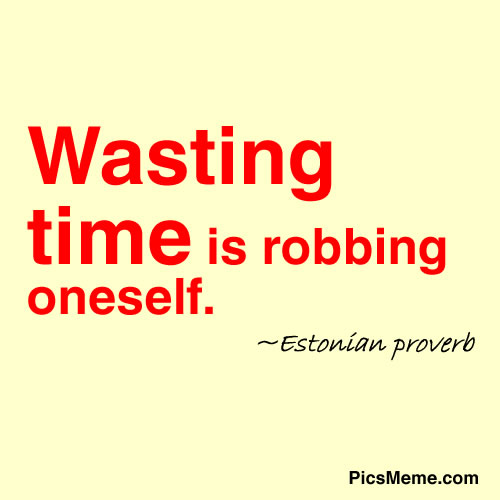
WASTING TIME IS ROBBING ONESELF - ESTONIAN PROVERB

The most important thing in life is to spend your time on things that are important and meaningful to you. Such things are like doing tasks relating to your long ranch goals, getting involved in your interests and passion, and spending quality time with your family. In order to do less and get more out of what you want in life, you have to avoid wasting time doing things that are non-essential and small stuff. Here are the top ten ways to save time:


1.      Television: You change your life forever on the day you stop watching TV. The time you spend on gluing to the tube can be used to do so many wonderful and productive things in life ( Productive Things You Can Do at Home in the evening when you Stop Watching TV ). The fact is that doing anything else is better than watching TV.

2.      Mobile phone: Actually the basic function of the telephone is to communicate important messages. Now, with the invention of the mobile phone, it is used to send text messages on trivial issues just to pass the time. Worse still, it is used to browse the Net for the sake of browsing.   

3.      Internet: Internet is a useful tool when it is used correctly to look for information or doing things relating to your job. Don’t do emailing or chatting for no purposes at all. Surfing the Net is another great sin.

4.      Time stealers: Avoid getting into a situation to allow someone to bump into you and chat endlessly just to take away your valuable time. Send him or her to the door politely. You have better things to do in life and time is short. 

5.      Newspapers: If you must read the papers all you need is about five minutes to scan the headlines. A headline tells the whole story in a nutshell. I read as fast as I can just to look for ideas for my articles and nothing else. Newspapers carry all the sensational news that dampens your spirits and discourages you to start a new day right. 

6.      Multitasking: Don’t do so many things at the same time in order to save time, it is counterproductive. You work under stress and you are prone to mistakes and you can’t concentrate. Focus on one task at a time to do a job right the first time.

7.      Not prepared: Not getting ready the material to do your job is courting for trouble. You will start hunting high and low for the tools and other necessary items. It is time-wasting and frustrating.

8.      Do not plan ahead: It is yet another way to waste time by not planning ahead. You could waste precious time doing the wrong things which are not important.

9.      A late starter: Time is more than wasted when you start a new day late. You will be rushing about to get things done badly. You miss deadlines and you get interrupted by people and phone calls. It is a mess. Start a new day early.

10.  Aimless living: This is truly a disaster in living a meaningful life. Don’t drift around aimlessly in life. It is more than a waste of time. It is a drain of energy and resources. Set goals and follow your dreams.


Actually, when you look at the list, these are things to avoid so that you don’t waste time. You will gain more time at your disposal. The rule is to spend more time on your goals and objectives and avoid doing things that have no impact on your life.


Tuesday, March 2, 2010

7 P’s of Time Management


Time Management
"Most of us spend too much time on what is urgent, and not enough time on what is important." - Steven Covey


1. Plan: What is your vision? What are the goals that you have set for yourself? Do you break down your goals into monthly, weekly, and daily tasks? Always carry with you a daily to-do list. It is a great tool to get things done.

2. Prioritize: Attend to a few important things in your to-do list especially those that are urgent and important.

3. Practical: Do not cram too much work in a day. Don’t create stress for yourself. Aim to work less and achieve more.

4. Proactive: Taking proactive steps is like taking preventive measures. As an example, a maintenance manager will devise a program to do routine servicing and checking of the plants and machinery. He will not allow a piece of machine to be out of order and go into an emergency situation. Putting out the fire is not his style of management Likewise, it is necessary to do continuous learning in order to hone your expertise. It is not urgent but it is important. The thing is that when an opportunity arises you are ready.

5. Practice: Planning and prioritizing are well and good but if you don’t put into action, nothing is going to happen.

6. Punctual: Go to work on time or be at the workplace earlier. Be on time for meetings and appointments. When you are late you waste not only your time but other people’s time as well. It does not reflect well on you.

7. Procrastinate: Do it now. Time is too precious to be wasted by delaying carrying out what you should be doing. Think of all the benefits of getting things done every day. It is a good habit in time management.


Manage your time more effectively with the 7 P’s.

Tuesday, January 19, 2010

10 Tips to Manage Your Time at Work

Time for Work
“A plan is what, a schedule is when. It takes both a plan and a schedule to get things done.”
Peter Turla
Here are ten ways to be productive at work:

1. Do a job once and for all: Do it right the first time. Make sure of what is expected and complete the job fully and without errors. Valuable time is wasted if you have to revise and redo something.

2. Priority your work: Do the most important and urgent tasks first. It is then followed by important tasks but not urgent. Only when you have the time you can proceed to urgent but not important tasks. The last thing is to tackle those that are not important and not urgent.

3. Ahead of time: When a job is to be completed in a day, make it a point to complete most of it by noon. In a way, you are relieved that the job is almost done. The other advantage is that when it is necessary to do amendment or adjustment you still have plenty of time. You are also appreciated by your boss for completing an assignment in advance.

4. To-do list: It is necessary to keep repeating that a to-do list is essential to manage your precious time and to follow the list and execute accordingly. Do not rely on your memory.

5. Start the day early: Get to the office earlier. You are not only avoiding the morning rush hour and you can start work right away without being disturbed by others.

6. Be mindful at work: When you have organized your day well you can concentrate fully on the task at hand. The do-do list plays such a vital role here. When your mind is not distracted you work efficiently and effectively.

7. Alternate your work: You may glue to your PC in the morning and then you switch to doing paperwork. In the afternoon you may meet your staff or clients and then go around walking about.

8. Be prepared: Examples like rehearsing before you do a presentation and discussing with other departmental beads before a meeting are such crucial steps to allow things to carry out smoothly.

9. Schedule: When an assignment is given verbally by your boss, write down the details, and get your boss’s confirmation and approval. The next thing is to break down the assignment into bit size and allocate a time frame for each task. Check the progress against the deadline and make allowance whenever necessary.

10. Avoid clutter: Do not let your mind be disturbed by piles of paper on your desk. Keep your workstation clean and tidy. Only items relating to your task at hand should be on your desk. On the other hand, proper filing allows the retrieving of documents easily and quickly.


A day’s job done well will leave you with a light heart and a happy note. You look forward to each new day with self-confidence. You are sure that it is going to be another great day at work.

Monday, April 13, 2009

Time Management is Life Management – 7 Things That Impact Your Life

Time management (Stock.xchng)
Time


According to Charles Buxton,” You will never find time for anything. If you want time you must make it.” You don’t manage time. The time is always there, you are given 24 hours every day. The best thing in life is to fill the time with meaningful activities that mean a lot to you.
Here are the 7 things that you can do to occupy your time and to create an impact in your life and in the life of others:


  1. Work: Are you able to do more in less time. Are you able to improve your productivity in the office? Have you discharged your duties and responsibilities to the best of your ability? Is your boss happy with your performance? What do you want your co-workers to say about you when you are not in the office?

  1. Family: How often do you spend quality time with your family? You have promised your children a Sunday outing to the beach and the children are still waiting for the day. You have suggested to your spouse to spend an evening with just two of you but your have not found the time to do it.

  1. Sleep: You cannot cut short you sleep just to do more. It does not work well this way. Having sufficient sleep will allow you to have your waking hours with peak energy and freshness of your mind to live a full day more efficiently and effectively.

  1. Exercise: This is the activity that you must do. Your health and well-being will make other activities work well. Have you devoted some time every day to be physically active?

  1. Interest and passion: One of the most important things in life is to fill the time with the things that you enjoy doing and you can do it better than other people and it also means a lot to you. As an example I enjoy blogging and I can post an article a day. I am happy that my articles are able to inspire, motivate, and cheer up the mood of my readers. To be able to impact the life of others means a lot to me.

  1. New Year‘s resolutions: You have decided to read one inspiring book every month and you have purchased the first book but you have not started reading it yet. You have intended to quit smoking but somehow it is not working out. You have…Start today and make it a habit so that whatever you have decided to do will transform your life for the better.

  1. Happiness: Is your happiness depends on something to happen in the future? Do not wait, make up you mind to be happy now. Appreciate and value every day of your life and be happy as what you are and enjoy every moment of your life. Life is too unpredictable to depend on something to happen in the future in order to be happy.


Do not procrastinate any more. Do it now. This could be the last time of your life to do so. Louis May Alcott says,” Make each day useful and cheerful and prove that you know the worth of time by employing it well. Then youth will be happy, elders will be without regret, and life will be a beautiful success.”
Related Posts Plugin for WordPress, Blogger...