Monday, July 7, 2014

10 Daily Habits of Productive People

Business Team - Vector 2
Efficiency is doing a thing right; effectiveness is doing the right thing. Productivity is doing the right thing the right way.

Productive people are successful in their own field of expertise. They work hard and they also work smart by getting important things done without hurrying by or under undue stress because they adopt similar daily productive habits.

1.      To-do list and daily routine: A to-do list works hand in hand with their daily routine. They have already established their productive routine and they will just slot in the daily tasks as stated in their to-do list for the day. The list is short and priority is given to the most important tasks and it is scheduled in the morning, their high energy period.      

2.      Daily exercise: Daily physical activity is an essential part of their productive daily habit. When it is carried out after work, it is to unwind, to recharge, and to refresh physically and mentally. They get outside to be with nature and breathe in the fresh air.  

3.      Early riser: According to an article, The Power of Mornings: Why Successful Entrepreneurs Get up Early, it is mentioned that for 15 years, Starbucks President Michelle Gaas has set her alarm for 4:30 a.m. to go running. Gretchen Ruben, popular author of The Happiness Project (Harper Perennial, 2011) wakes up at 6 a.m. and works for an hour before her family rises. They have established a regular sleep routine to enjoy a good night’s sleep for around 8 hours. When they are up and about early they have ample time to have a workout, a healthy breakfast, and the time to visualize the day ahead of them.

4.      Learn: Productive people are constantly learning; they ask questions. They are curious and they want to know more so that they can apply what they have learnt to practical uses and be more productive.   

5.      Positive outlook: They are many ways productive people stay positive. They get support from positive people and when they work they are able to  reduce their stress levels to a minimum because they are proactive and are able to manage their time effectively

6.      Do it now: Taking action is the hallmark of productive people. They plan and they execute their plan. They will not do things all by themselves but employing skillful delegation to get things done.

7.      Live now: Mindfulness is focused attention on the present. It is a productive habit. Productive people avoid multitasking and reduce distractions to the minimum. At work, their mind is here and now. In a 2011 Vogue feature, Arianna Huffington, President & Editor-in-Chief, Huffington Post Media Group described early-morning yoga and meditation as two of her "joy triggers.” Huffington has spoken out on the benefits of mindfulness not just for individual health, but also for corporate bottom lines. "Stress-reduction and mindfulness don't just make us happier and healthier, they're a proven competitive advantage for any business that wants one," she wrote in a recent blog.

8.      Think, plan ahead and be prepared: Productive people do not put out a fire. They are proactive and take preventative measures to avoid emergency situations just like a maintenance manager in a factory doing regular checking with a checklist. In the case of busy entrepreneurs, they foresee challenging situations ahead of them and work out a flexible plan. They are prepared; they visualize the end result and work backward.

9.      Gratitude: According to an article, Increasing Productivity with Gratitude, it is mentioned that increasing productivity with gratitude is, indeed, a highly effective process. Why? In a nutshell, giving and receiving thanks increases the release of dopamine, therefore raising your energy. This neurotransmitter plays a critical role in the function of the central nervous system, and it is also linked with the brain's complex system of motivation and reward. Who doesn't feel more productive and content where higher levels of motivation and reward are involved?  Productive people keep a gratitude journal and write a few things that they are grateful for every day. They say thank you more often and they express appreciation regularly to the right people.


10.  Taking breaks: Productive people are not ruthless to get more done. They know it is counterproductive. They take breaks and especially their lunch break. They get out of their workplace and get outside for a change of environment to relieve tiredness and exhaustion and to refresh the mind.


Conclusion

Productive people are the master of time and tasks. They are focused on the things that produce results. They have time for work, play, family, and for themselves alone. They know what is important in their life and they allocate time to do it every day. They are super achievers and at the end of each day, they are satisfied and happy with what they have accomplished for the day. 

Sunday, July 6, 2014

16 Things Extremely Likeable People Do

16 Things Extremely Likeable People Do
Source: Shutterstock
Being likeable has its benefits — you'll have an easier time scoring your dream job and making friends. Recently, some Redditors shared some advice for making yourself more likeable. Here are some of the top tips:
  1. They smile — a lot. Seeing a smile makes other people happy, so if you're smiling when you're interacting with someone, he'll find you easy to like and friendly.
  2. They ask people questions. There's nothing people love more than to talk about themselves. They will find the conversation more memorable and positive if they spend time talking about themselves.
  3. They pay attention. Listen more to other people than you speak, and people will feel valued. Even if you're asking questions, people won't warm up to that if it seems you're not listening to what they're saying.
  4. They remember names. Names are such a core part of people's identity. Bringing their names up in the conversation will not only make them feel good, but they'll also appreciate the fact that you remember their names.
  5. They repeat and reinforce. Repeating what someone said to you and reinforcing it will help people feel validated. And that's all people want — validation.
  6. They don't give unsolicited advice. Give advice to people when they ask you for it. If you go around telling people your opinion, you can come across as being overbearing and bossy even if you're just trying to help.
  7. They don't make everything a competition. Trying to compete with everyone and one-up everything people say can quickly make you less likeable in their eyes.
  8. They take responsibility. If you make a mistake, take responsibility for it. Acknowledge it, and don't point the blame at someone else.
  9. They get off their phones. People appreciate undivided attention because it makes them feel like you're truly listening to them. It makes them feel that you value their presence and time.
  10. They don't make comparisons all the time and make it all about them. If you make a mistake, take responsibility for it. Acknowledge it, and don't point the blame at someone else.
  11. They don't keep interrupting. You may get overexcited and interrupt people while they are talking, which can annoy them. It makes them feel that what they have to say is not that important to you.
  12. They make eye contact. Making the right amount of eye contact with someone can help them feel a rapport with you. You'll also come across as being more confident and trustworthy.
  13. They accept that other people will disagree with them. Everyone has different opinions — learn to be OK with that. Your way may not always be the right way for others, so don't try to convince them that they're wrong. Embrace your differences.
  14. They don't constantly seek sympathy and attention. Likeable people don't need to constantly seek sympathy and attention to feel better about themselves.
  15. They don't try too hard. Focus on making yourself happy first, and people will gravitate toward you. If you try too hard, people can see through that.
  16. They have good hygiene. Wear clean clothes, brush your teeth, and take showers.

    Source:16 Things Extremely Likeable People Do

Saturday, July 5, 2014

11 Things Slim People Do Every Day

11 Things Slim People Do Every Day

Get enough sleep

To stay slim you need to keep up with your beauty sleep. Between 6.5 and 8.5 hours of it in fact, according to researchers at Brigham Young University. The researchers discovered that people who regularly slept for this long every night had lower body fat percentages than those who had irregular sleeping patterns.


Eat upside down

Don't worry, we aren't going to have you standing on your head to eat meals. This tip comes from 'Biggest Loser' expert Devin Alexander. Whenever you need to season food, season the bottom of it instead of the top - for example, buttering the bottom of a slice of toast. When you bite into the food, the flavour will instantly hit your tongue, and you'll need less seasoning or butter to get the taste you want.


Keep a food diary

One of the best ways to speed up your slimming journey is to keep a daily food diary. Note down what you eat, when you ate it, and a rough calorie count for every day. Participants in a study at the Kaiser Permanente Center for Health Research who kept a daily food diary lost twice as much weight as the participants who didn't keep any record of their eating habits.


Measure your waist

If you're working out in the gym in your attempts to slim, then you should start measuring your waist rather than your weight to track your progress. Whilst body fat can fluctuate depending on muscle mass, your waist size won't lie, and will act as accurate proof that your efforts are paying off.


Brush your teeth after every meal

This daily slimming tip comes with the added bonus of minty fresh breath. According to speakers at an American Dental Association, brushing your teeth after every meal can help with weight loss. Brushing your teeth acts as a subliminal signal to your brain that it's time to stop eating, which prevents any sneaky post-meal snacking.


Give food your full attention

The next time you sit down for a meal, turn your TV off, hide your phone, and focus your attention on your food. A study at the University of Bristol made the shocking discovery that distracted people eat up to twice as much as people who enjoy their food at a table with no distractions.


Chew your food

If you regularly face a busy workday, you'll no doubt be used to wolfing down your food in five seconds flat in a bid to get your lunch out of the way as quickly as possible. Whilst this may boost your working life, it'll also expand your waistline. Researchers in Japan observed that women who ate more slowly also felt full much more quickly, and ate few calories overall.


Eat more fibre

If your diet doesn't contain enough fibre, then you'll struggle to stay slim. Fibre keeps you full for longer and ensures you don't snack between meals. It also helps to cut back on the calories your body absorbs - in one study; women who doubled their fibre intake absorbed 90 fewer calories every day.


Obey your cravings

From time to time, your body will crave something less than healthy, and you need to listen to it. But not in the way you might think. With nutritious substitutes, you can obey any craving without stalling your slimming mission. For example, if you want something sweet, reach for fresh fruit instead of sugary snacks.


Keep your food and packaging separate

If you give in to temptation and eat a packet of crisps or a chocolate bar, your brain automatically assumes that eating everything the packaging contains counts as one portion. Instead, separate your food from its packaging and you'll find you eat much less. For example, instead of stuffing a chocolate bar into your bag, break off a couple of squares and put them in a container to be enjoyed as a sweet treat in the afternoon.


Drink lemon water

Adding a slice or two of lemon to your water gives you much more than a bit of extra zing. Not only will the added flavour encourage you to drink more water, but lemons also contain a whole host of healthy extras like vitamin C, vitamin B, and potassium. The citric acid it contains will also help to flush out your system, leaving you feeling cleansed and energised.


Friday, July 4, 2014

The One Skill Almost Nobody Has And Everyone Needs

Public Speaking
“Public Speaking is a skill and, almost nobody has it,” writes columnist Joe Queenan in this recent Wall Street Journal essay. I agree. Public speaking is a skill and, like any other skill, it requires hours and hours of refinement to improve it. It takes years of speaking for many leaders who I’ve met to gain the confidence they need to captivate an audience.
One strategy that significantly reduces the amount of time it requires to hone public speaking skills is to study the world’s best communicators, something I’ve been doing for the better part of 30 years. I like to show leaders contemporary examples of magnificent presentations so they can actually see themselves adopting the techniques of great speakers in their very next sales pitch or PowerPoint presentation. Here are three examples that can help you
Use humor like Craig Federighi. At the most recent Apple developers conference (WWDC 14), CEO Tim Cook introduced the senior vice president of engineering, Craig Federighi, as “Superman.” Federighi did put on a super show, commanding about 70 percent of the entire presentation. Federighi engaged the audience with his energy, polish, smooth demonstrations, and, above all, his sense of humor.
Federighi kicked off a discussion of the new Apple operating system, “Yosemite,” by poking fun at the “crack product marketing team” that develops names. “We shoved them in their VW minibus and set them out on the road. They ventured south and discovered OS X Oxnard…before boldly venturing north, landing at OS X ‘weed.’ Strangely, this had large pockets of support within the product marketing organization,” Federighi said as 6,000 attendees laughed and cheered.
Throughout the presentation, he poked good-natured fun at himself (with a few references to his mane of gray hair which he jokingly calls “hair force one”). He’s not above flashing devil horns on his fingers when introducing Metal, Apple’s new gaming program system. Federighi even brings his mom into the act. When he was demonstrating new phone features of the iOS devices he was interrupted by a call from his mother (all of this is planned and rehearsed, of course). “She surely wants to grill me about the newest fourth-tier LVM compiler, but this is not the right time,” as he hung up on her. The audience good-naturedly groaned. “I’m sorry,” Federighi responded. “She’s a wonderful, wonderful woman, but this is my space,” he said with a smile.
Most business presentations are dry, boring, stuffy, and stiff. Federighi didn’t get the memo. A compelling presentation should inform, educate, and entertain.
Tell a story like Sheryl SandbergFacebook COO Sheryl Sandberg launched a movement called Lean In. I’ve argued that millions of women would not be “leaning in” to the workplace if it had not been for a story Sandberg told about her own challenges as a working mother. It started with Sandberg’s now-famous TED topic on Why We Have Too Few Women Leaders. Sandberg recently acknowledged that her original presentation was “chock full of data, and no personal stories.” A friend convinced Sandberg to break down the walls and to tell authentic and personal stories about her own struggles with being a working mother. Sandberg did, the video went viral, and launched a movement.
Telling stories is the single best way to make an emotional connection with your listener. Stories inform, illuminate, and inspire.  So few leaders use storytelling effectively that simply by incorporating more stories in your presentations, you’ll stand apart.
Have a conversation like Bryan Stevenson. Civil rights attorney Bryan Stevenson successfully wins cases that he argues before the U.S. Supreme Court. Stevenson also has the notable distinction of attracting the longest standing ovation in TED talk history. Stevenson likes to tell stories, too. In my analysis of his presentation, stories made up 65 percent of the content, a far higher percentage of stories than you’ll find in most average presentations.
Stevenson is also notable for his impeccable delivery. After reviewing hundreds of TED presentations as well as many other presentations in my career as a journalist and communications coach, I’m convinced that Stevenson has the most comfortable pacing of any public speaker I’ve seen. He’s not reading to his audience; he’s having a conversation instead.
When I asked Stevenson about his speaking style, he told me that he likes to sound like he’s talking to a friend over dinner in a restaurant. His speaking pace is about 190 words a minute, slightly faster than the average business speaker but slower than a super high-energy motivational speaker like Tony Robbins, who can speak at 225 words a minute. I don’t want you to get caught up in counting words, but I do want you to pay attention to your delivery and pace of speaking. Sound natural, and not like you’re “reading” a script. Use Stevenson’s guideline—think about how you’d sound if you were enjoying a conversation with a friend over dinner.
“Nothing is more grueling than having to listen to…amateurs who don’t know they are amateurs,” wrote The Wall Street Journal’s Joe Queenan, referring to the skill level of the average public speaker. Amateurs in any field become experts only by learning from the best and then practicing their tails off. Federighi, Sandberg, and Stevenson offer valuable public speaking lessons for any business leader who wants to leave the amateur ranks and join the elite.
Source: The One Skill Almost Nobody Has And Everyone Needs

Thursday, July 3, 2014

14 Effective Ways to Market Your Blog

Blog
There are many ways to promote and attract people to notice your blog. The following are the methods that I use to market my blog and you can do it without costing a single cent with the exception of offline marketing:   

1.      Social media: The most popular and effective way is through social networking sites such as Facebook, Twitter,   Pinterest, Scoop.it and Linkin. Update your social media sites with each new post on your blog. The most important thing to do is to connect with others and make friends.

2.      Slide share: Turn your popular blog posts into slides and release them at SlideShare.  Educational articles are the most suitable ones to turn into slides. I use Microsoft PowerPoint to create my slides.     

3.      Press release:  Do a press release and link it to your site at Free Press Release. Before you do so find out if it is newsworthy.

4.      Guest posts: You can see a list of my guest posts here. In each post, there is a link to my blog.   Make sure your guest post is relevant to the intended website and your article is worthy to be accepted.  

5.      Email and RSS feed: Do you provide email subscriptions and RSS feed for your blog? You will notice them at the top of the sidebar. Make it easy for readers to subscribe to your articles.     

6.      Amazon: Get readers from Amazon to read your blog posts on the go on Kindle. Go to https://kindlepublishing.amazon.com and click on the "Create a new account" button. Besides, you get paid when readers subscribe to your blog.  You don't get to choose pricing - Amazon does, based on what it believes is fair. This means $0.99 or $1.99 per month for most blogs. You only get 30% of the subscription revenue.

7.      Blog carnival: Joining blog carnivals is another effective way to get people to visit your site.  Match your article to the carnival of your choice.

8.      Social bookmarking sites: Delicious, Digg, StumbleUpon, and Reddit are some of the sites to expose your site. You should post randomly your articles and at the same time promote other people’s articles.     

9.      Offline: In your community, you can distribute your business cards, car stickers, flyers, and gifts such as memo pads and pens with your website address printed.

10.  E-books: You can turn your articles into e-books and in each e-book provide links to your blog. You can refer my article about writing an e-book.

11.  Article directories: There are so many article directory sites around and EzineArticles and TRCB.com are two of such sites. Send your best posts to be accepted. There is a link to your blog at the end of each post.

12.   Comments on other blogs: In order to get notices it is wise to comment early when a new post is uploaded. Provide value for your input like giving an example, adding a point, and proving a helpful link of high relevancy. 


13.   Blog directories: One interesting directory that I am using is Blog Top List. It shows your daily ranking among other blogs of the same niche.

     14,   Blog communities: Joining relevant groups to get wider exposure to your blog is an excellent idea. I am a member of  Alltop and Yakezie.

It goes without saying that posting unique articles regularly on your site is a top priority before you can embark on your marketing campaign. You want to create a good first impression and turn your casual visitors into loyal followers.

How many ways have you tried? What are the other ways you have done? Share with us. 

Wednesday, July 2, 2014

WHAT THE HAPPIEST PEOPLE KNOW ABOUT WORK


[Image: Flickr user Chris Hearn]

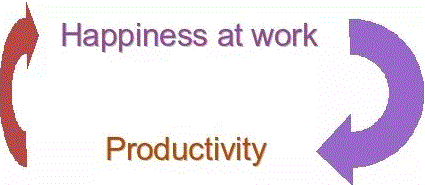
Happiness at work and Productivity

HARD WORK AND SKILLS WILL ONLY GET YOU SO FAR. THE MOST SUCCESSFUL PEOPLE ALSO FIND JOY IN WORKING LIFE. IT'S NOT AS DIFFICULT AS IT MAY SEEM. HERE ARE THE TOP HABITS FOR PEOPLE WHO ARE HAPPY AT WORK.


Study, work hard, and you will be successful.
This was the mantra repeated by educators throughout my youth. None of them added "be happy" to the success equation.
But a growing body of research in positive psychology and neuroscience is demonstrating that happiness is the secret ingredient to success. It turns out, our brains are more engaged, creative, productive, and resilient when in a positive state.
Jim Donovan, consultant, speaker and proclaimed "happiness expert" offers workplace advice to employers and employees on how to make their work lives more fulfilling. His latest book Happy @ Work comes on the heels of a Gallup poll that reported employee disengagement in the U.S. as high as 70%.
All this unhappiness comes with a high price tag to businesses, costing more than $550 billion a year in lost productivity. In his book, Donovan identifies 60 simple steps individuals can take to improve their happiness and get back on the path to success. Here are six of the top things happy workers do:

CHANGE THE WORD “PROBLEM” TO “CHALLENGE.”

“Problems tend to be things we try to avoid, while challenges are things we step up to fix,” writes Donovan. Making this minor change in vocabulary can have a big impact on how you deal with a situation. A challenge can be interpreted as an opportunity to showcase your talents or learn a new skill.

MIX UP YOUR DAILY ROUTINE.

Many of us get stuck in the daily rut; driving the same route to work, eating the same breakfast, starting the day by filtering through emails. Changing up our routine stimulates the brain, enhancing creativity and happiness. “By changing your everyday patterns and habitual processes, you will be creating new neural connections in your brain.
Simply changing your route to and from work will expose you to new visual and auditory stimuli, [for example],” writes Donovan. This explains why extraordinary thinkers such as Steve Jobs and Steven Spielberg were known to on long walks to stimulate breakthrough ideas.

START THE DAY WITH THE BIG QUESTIONS.

Asking yourself a series of empowering questions such as “what am I looking forward to today?”, “What am I grateful for today?” first thing in the morning can have you starting the day with purpose and get your brain into a positive state.

ARRIVE AT WORK EARLY.

Nothing can damper a mood faster than getting stuck in rush hour traffic. Leaving home even 20 minutes earlier can have you arriving at the office in a less frazzled state, giving you some extra time to ease into the day ahead, and grab that first cup of coffee in peace.
Have an office playlist. Music is a feel-good tool. If you’ve ever heard a song that immediately transports you to a past event, you know the power of music. Music can improve how you feel at work or in any given situation. Donovan recommends developing a feel-good playlist and notes even Olympic medalist Michael Phelps was seen bopping to his iPod moments before breaking the world record for winning the most Olympic medals.

AVOID ENERGY ZAPPERS.

You know who they are; those people who go on for hours about their personal problems, the latest international disaster, or the traffic jam on the freeway. These individuals appear obsessed with finding something wrong in every situation.
When possible, attempt to surround yourself with winners; those who are positive and uplifting and just seem to radiate happiness.
Source: WHAT THE HAPPIEST PEOPLE KNOW ABOUT WORK

Tuesday, July 1, 2014

How to be Sincere and Straightforward

Yellow Lab
“Hold faithfulness and sincerity as first principles.” - Confucius

According to the Oxford Advanced Learner’s Dictionary, sincere means saying only what you really think or feel, while straightforward means honest and open; not trying to deceive somebody or hide something.

How do you tell your girlfriend that her dress is not appropriate for her? Are you going to be sincere and straightforward? More likely than not, if you do, you will not hear from her again or she will not talk to you for a few days. People like to be flattered and hear positive things.

How do you apply sincerity and straightforwardness?

At Home: They are the people close to you, especially your children. There is no need to beat around the bush. Tell it like it is. When you know it is harmful to place your smartphone next to you while sleeping, talk to your children that mobile phones use electromagnetic radiation in the microwave range. Explain the risks involved and the best way to deal with them.

Among friends: If he or she is your close buddy, they will listen to you without feeling being irritated or annoyed. They know your intention is good for them. For casual acquaintances, there is no need to comment. If requested you still can be honest and diplomatic about it. Like the case of the dress mentioned above. You can suggest a different color or a different style bring out her best without directly telling her that the dress does not suit her.  

At work: In the office honesty is the best policy. You are working in the best interest of the company. When you have a better idea you are to put forwards your recommendation and your reasoning. Others may be jealous because their plan is not good enough; but it is their negative thinking. There is no need to win their consent when you know what you do is right. 

When you are sincere and straightforward, it is from your heart. You behave the same in front of others or alone. When you do something you know it is the right thing to do and there is no ulterior motive.  Your response is genuine and spontaneous.

 Conclusion: It is a virtue to be sincere and straightforward. However, it depends on the person you are talking to. When you know you can be candid about it be sincere and straightforward. Otherwise, you still can deliver your message in a subtle way and not offend the other party. 


Sincerity is strength and the very foundation of character. Sincere people are passionate, driven & positive. They not only aim high for themselves but they also lift others.
Related Posts Plugin for WordPress, Blogger...