Saturday, July 5, 2014

11 Things Slim People Do Every Day

11 Things Slim People Do Every Day

Get enough sleep

To stay slim you need to keep up with your beauty sleep. Between 6.5 and 8.5 hours of it in fact, according to researchers at Brigham Young University. The researchers discovered that people who regularly slept for this long every night had lower body fat percentages than those who had irregular sleeping patterns.


Eat upside down

Don't worry, we aren't going to have you standing on your head to eat meals. This tip comes from 'Biggest Loser' expert Devin Alexander. Whenever you need to season food, season the bottom of it instead of the top - for example, buttering the bottom of a slice of toast. When you bite into the food, the flavour will instantly hit your tongue, and you'll need less seasoning or butter to get the taste you want.


Keep a food diary

One of the best ways to speed up your slimming journey is to keep a daily food diary. Note down what you eat, when you ate it, and a rough calorie count for every day. Participants in a study at the Kaiser Permanente Center for Health Research who kept a daily food diary lost twice as much weight as the participants who didn't keep any record of their eating habits.


Measure your waist

If you're working out in the gym in your attempts to slim, then you should start measuring your waist rather than your weight to track your progress. Whilst body fat can fluctuate depending on muscle mass, your waist size won't lie, and will act as accurate proof that your efforts are paying off.


Brush your teeth after every meal

This daily slimming tip comes with the added bonus of minty fresh breath. According to speakers at an American Dental Association, brushing your teeth after every meal can help with weight loss. Brushing your teeth acts as a subliminal signal to your brain that it's time to stop eating, which prevents any sneaky post-meal snacking.


Give food your full attention

The next time you sit down for a meal, turn your TV off, hide your phone, and focus your attention on your food. A study at the University of Bristol made the shocking discovery that distracted people eat up to twice as much as people who enjoy their food at a table with no distractions.


Chew your food

If you regularly face a busy workday, you'll no doubt be used to wolfing down your food in five seconds flat in a bid to get your lunch out of the way as quickly as possible. Whilst this may boost your working life, it'll also expand your waistline. Researchers in Japan observed that women who ate more slowly also felt full much more quickly, and ate few calories overall.


Eat more fibre

If your diet doesn't contain enough fibre, then you'll struggle to stay slim. Fibre keeps you full for longer and ensures you don't snack between meals. It also helps to cut back on the calories your body absorbs - in one study; women who doubled their fibre intake absorbed 90 fewer calories every day.


Obey your cravings

From time to time, your body will crave something less than healthy, and you need to listen to it. But not in the way you might think. With nutritious substitutes, you can obey any craving without stalling your slimming mission. For example, if you want something sweet, reach for fresh fruit instead of sugary snacks.


Keep your food and packaging separate

If you give in to temptation and eat a packet of crisps or a chocolate bar, your brain automatically assumes that eating everything the packaging contains counts as one portion. Instead, separate your food from its packaging and you'll find you eat much less. For example, instead of stuffing a chocolate bar into your bag, break off a couple of squares and put them in a container to be enjoyed as a sweet treat in the afternoon.


Drink lemon water

Adding a slice or two of lemon to your water gives you much more than a bit of extra zing. Not only will the added flavour encourage you to drink more water, but lemons also contain a whole host of healthy extras like vitamin C, vitamin B, and potassium. The citric acid it contains will also help to flush out your system, leaving you feeling cleansed and energised.


Friday, July 4, 2014

The One Skill Almost Nobody Has And Everyone Needs

Public Speaking
“Public Speaking is a skill and, almost nobody has it,” writes columnist Joe Queenan in this recent Wall Street Journal essay. I agree. Public speaking is a skill and, like any other skill, it requires hours and hours of refinement to improve it. It takes years of speaking for many leaders who I’ve met to gain the confidence they need to captivate an audience.
One strategy that significantly reduces the amount of time it requires to hone public speaking skills is to study the world’s best communicators, something I’ve been doing for the better part of 30 years. I like to show leaders contemporary examples of magnificent presentations so they can actually see themselves adopting the techniques of great speakers in their very next sales pitch or PowerPoint presentation. Here are three examples that can help you
Use humor like Craig Federighi. At the most recent Apple developers conference (WWDC 14), CEO Tim Cook introduced the senior vice president of engineering, Craig Federighi, as “Superman.” Federighi did put on a super show, commanding about 70 percent of the entire presentation. Federighi engaged the audience with his energy, polish, smooth demonstrations, and, above all, his sense of humor.
Federighi kicked off a discussion of the new Apple operating system, “Yosemite,” by poking fun at the “crack product marketing team” that develops names. “We shoved them in their VW minibus and set them out on the road. They ventured south and discovered OS X Oxnard…before boldly venturing north, landing at OS X ‘weed.’ Strangely, this had large pockets of support within the product marketing organization,” Federighi said as 6,000 attendees laughed and cheered.
Throughout the presentation, he poked good-natured fun at himself (with a few references to his mane of gray hair which he jokingly calls “hair force one”). He’s not above flashing devil horns on his fingers when introducing Metal, Apple’s new gaming program system. Federighi even brings his mom into the act. When he was demonstrating new phone features of the iOS devices he was interrupted by a call from his mother (all of this is planned and rehearsed, of course). “She surely wants to grill me about the newest fourth-tier LVM compiler, but this is not the right time,” as he hung up on her. The audience good-naturedly groaned. “I’m sorry,” Federighi responded. “She’s a wonderful, wonderful woman, but this is my space,” he said with a smile.
Most business presentations are dry, boring, stuffy, and stiff. Federighi didn’t get the memo. A compelling presentation should inform, educate, and entertain.
Tell a story like Sheryl Sandberg. Facebook COO Sheryl Sandberg launched a movement called Lean In. I’ve argued that millions of women would not be “leaning in” to the workplace if it had not been for a story Sandberg told about her own challenges as a working mother. It started with Sandberg’s now-famous TED topic on Why We Have Too Few Women Leaders. Sandberg recently acknowledged that her original presentation was “chock full of data, and no personal stories.” A friend convinced Sandberg to break down the walls and to tell authentic and personal stories about her own struggles with being a working mother. Sandberg did, the video went viral, and launched a movement.
Telling stories is the single best way to make an emotional connection with your listener. Stories inform, illuminate, and inspire.  So few leaders use storytelling effectively that simply by incorporating more stories in your presentations, you’ll stand apart.
Have a conversation like Bryan Stevenson. Civil rights attorney Bryan Stevenson successfully wins cases that he argues before the U.S. Supreme Court. Stevenson also has the notable distinction of attracting the longest standing ovation in TED talk history. Stevenson likes to tell stories, too. In my analysis of his presentation, stories made up 65 percent of the content, a far higher percentage of stories than you’ll find in most average presentations.
Stevenson is also notable for his impeccable delivery. After reviewing hundreds of TED presentations as well as many other presentations in my career as a journalist and communications coach, I’m convinced that Stevenson has the most comfortable pacing of any public speaker I’ve seen. He’s not reading to his audience; he’s having a conversation instead.
When I asked Stevenson about his speaking style, he told me that he likes to sound like he’s talking to a friend over dinner in a restaurant. His speaking pace is about 190 words a minute, slightly faster than the average business speaker but slower than a super high-energy motivational speaker like Tony Robbins, who can speak at 225 words a minute. I don’t want you to get caught up in counting words, but I do want you to pay attention to your delivery and pace of speaking. Sound natural, and not like you’re “reading” a script. Use Stevenson’s guideline—think about how you’d sound if you were enjoying a conversation with a friend over dinner.
“Nothing is more grueling than having to listen to…amateurs who don’t know they are amateurs,” wrote The Wall Street Journal’s Joe Queenan, referring to the skill level of the average public speaker. Amateurs in any field become experts only by learning from the best and then practicing their tails off. Federighi, Sandberg, and Stevenson offer valuable public speaking lessons for any business leader who wants to leave the amateur ranks and join the elite.
Source: The One Skill Almost Nobody Has And Everyone Needs

Thursday, July 3, 2014

14 Effective Ways to Market Your Blog

Blog
There are many ways to promote and attract people to notice your blog. The following are the methods that I use to market my blog and you can do it without costing a single cent with the exception of offline marketing:   

1.      Social media: The most popular and effective way is through social networking sites such as Facebook, Twitter,   Pinterest, Scoop.it and Linkin. Update your social media sites with each new post on your blog. The most important thing to do is to connect with others and make friends.

2.      Slide share: Turn your popular blog posts into slides and release them at SlideShare.  Educational articles are the most suitable ones to turn into slides. I use Microsoft PowerPoint to create my slides.     

3.      Press release:  Do a press release and link it to your site at Free Press Release. Before you do so find out if it is newsworthy.

4.      Guest posts: You can see a list of my guest posts here. In each post, there is a link to my blog.   Make sure your guest post is relevant to the intended website and your article is worthy to be accepted.  

5.      Email and RSS feed: Do you provide email subscriptions and RSS feed for your blog? You will notice them at the top of the sidebar. Make it easy for readers to subscribe to your articles.     

6.      Amazon: Get readers from Amazon to read your blog posts on the go on Kindle. Go to https://kindlepublishing.amazon.com and click on the "Create a new account" button. Besides, you get paid when readers subscribe to your blog.  You don't get to choose pricing - Amazon does, based on what it believes is fair. This means $0.99 or $1.99 per month for most blogs. You only get 30% of the subscription revenue.

7.      Blog carnival: Joining blog carnivals is another effective way to get people to visit your site.  Match your article to the carnival of your choice.

8.      Social bookmarking sites: Delicious, Digg, StumbleUpon, and Reddit are some of the sites to expose your site. You should post randomly your articles and at the same time promote other people’s articles.     

9.      Offline: In your community, you can distribute your business cards, car stickers, flyers, and gifts such as memo pads and pens with your website address printed.

10.  E-books: You can turn your articles into e-books and in each e-book provide links to your blog. You can refer my article about writing an e-book.

11.  Article directories: There are so many article directory sites around and EzineArticles and TRCB.com are two of such sites. Send your best posts to be accepted. There is a link to your blog at the end of each post.

12.   Comments on other blogs: In order to get notices it is wise to comment early when a new post is uploaded. Provide value for your input like giving an example, adding a point, and proving a helpful link of high relevancy. 


13.   Blog directories: One interesting directory that I am using is Blog Top List. It shows your daily ranking among other blogs of the same niche.

     14,   Blog communities: Joining relevant groups to get wider exposure to your blog is an excellent idea. I am a member of  Alltop and Yakezie.

It goes without saying that posting unique articles regularly on your site is a top priority before you can embark on your marketing campaign. You want to create a good first impression and turn your casual visitors into loyal followers.

How many ways have you tried? What are the other ways you have done? Share with us. 

Wednesday, July 2, 2014

WHAT THE HAPPIEST PEOPLE KNOW ABOUT WORK


[Image: Flickr user Chris Hearn]

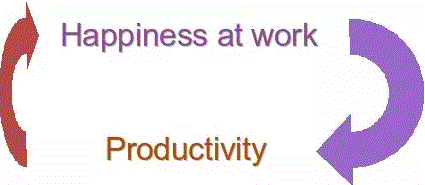
Happiness at work and Productivity

HARD WORK AND SKILLS WILL ONLY GET YOU SO FAR. THE MOST SUCCESSFUL PEOPLE ALSO FIND JOY IN WORKING LIFE. IT'S NOT AS DIFFICULT AS IT MAY SEEM. HERE ARE THE TOP HABITS FOR PEOPLE WHO ARE HAPPY AT WORK.


Study, work hard, and you will be successful.
This was the mantra repeated by educators throughout my youth. None of them added "be happy" to the success equation.
But a growing body of research in positive psychology and neuroscience is demonstrating that happiness is the secret ingredient to success. It turns out, our brains are more engaged, creative, productive, and resilient when in a positive state.
Jim Donovan, consultant, speaker and proclaimed "happiness expert" offers workplace advice to employers and employees on how to make their work lives more fulfilling. His latest book Happy @ Work comes on the heels of a Gallup poll that reported employee disengagement in the U.S. as high as 70%.
All this unhappiness comes with a high price tag to businesses, costing more than $550 billion a year in lost productivity. In his book, Donovan identifies 60 simple steps individuals can take to improve their happiness and get back on the path to success. Here are six of the top things happy workers do:

CHANGE THE WORD “PROBLEM” TO “CHALLENGE.”

“Problems tend to be things we try to avoid, while challenges are things we step up to fix,” writes Donovan. Making this minor change in vocabulary can have a big impact on how you deal with a situation. A challenge can be interpreted as an opportunity to showcase your talents or learn a new skill.

MIX UP YOUR DAILY ROUTINE.

Many of us get stuck in the daily rut; driving the same route to work, eating the same breakfast, starting the day by filtering through emails. Changing up our routine stimulates the brain, enhancing creativity and happiness. “By changing your everyday patterns and habitual processes, you will be creating new neural connections in your brain.
Simply changing your route to and from work will expose you to new visual and auditory stimuli, [for example],” writes Donovan. This explains why extraordinary thinkers such as Steve Jobs and Steven Spielberg were known to on long walks to stimulate breakthrough ideas.

START THE DAY WITH THE BIG QUESTIONS.

Asking yourself a series of empowering questions such as “what am I looking forward to today?”, “What am I grateful for today?” first thing in the morning can have you starting the day with purpose and get your brain into a positive state.

ARRIVE AT WORK EARLY.

Nothing can damper a mood faster than getting stuck in rush hour traffic. Leaving home even 20 minutes earlier can have you arriving at the office in a less frazzled state, giving you some extra time to ease into the day ahead, and grab that first cup of coffee in peace.
Have an office playlist. Music is a feel-good tool. If you’ve ever heard a song that immediately transports you to a past event, you know the power of music. Music can improve how you feel at work or in any given situation. Donovan recommends developing a feel-good playlist and notes even Olympic medalist Michael Phelps was seen bopping to his iPod moments before breaking the world record for winning the most Olympic medals.

AVOID ENERGY ZAPPERS.

You know who they are; those people who go on for hours about their personal problems, the latest international disaster, or the traffic jam on the freeway. These individuals appear obsessed with finding something wrong in every situation.
When possible, attempt to surround yourself with winners; those who are positive and uplifting and just seem to radiate happiness.
Source: WHAT THE HAPPIEST PEOPLE KNOW ABOUT WORK

Tuesday, July 1, 2014

How to be Sincere and Straightforward

Yellow Lab
“Hold faithfulness and sincerity as first principles.” - Confucius

According to the Oxford Advanced Learner’s Dictionary, sincere means saying only what you really think or feel, while straightforward means honest and open; not trying to deceive somebody or hide something.

How do you tell your girlfriend that her dress is not appropriate for her? Are you going to be sincere and straightforward? More likely than not, if you do, you will not hear from her again or she will not talk to you for a few days. People like to be flattered and hear positive things.

How do you apply sincerity and straightforwardness?

At Home: They are the people close to you, especially your children. There is no need to beat around the bush. Tell it like it is. When you know it is harmful to place your smartphone next to you while sleeping, talk to your children that mobile phones use electromagnetic radiation in the microwave range. Explain the risks involved and the best way to deal with them.

Among friends: If he or she is your close buddy, they will listen to you without feeling being irritated or annoyed. They know your intention is good for them. For casual acquaintances, there is no need to comment. If requested you still can be honest and diplomatic about it. Like the case of the dress mentioned above. You can suggest a different color or a different style bring out her best without directly telling her that the dress does not suit her.  

At work: In the office honesty is the best policy. You are working in the best interest of the company. When you have a better idea you are to put forwards your recommendation and your reasoning. Others may be jealous because their plan is not good enough; but it is their negative thinking. There is no need to win their consent when you know what you do is right. 

When you are sincere and straightforward, it is from your heart. You behave the same in front of others or alone. When you do something you know it is the right thing to do and there is no ulterior motive.  Your response is genuine and spontaneous.

 Conclusion: It is a virtue to be sincere and straightforward. However, it depends on the person you are talking to. When you know you can be candid about it be sincere and straightforward. Otherwise, you still can deliver your message in a subtle way and not offend the other party. 


Sincerity is strength and the very foundation of character. Sincere people are passionate, driven & positive. They not only aim high for themselves but they also lift others.

Monday, June 30, 2014

10 Ways You Can Bend Time to Improve Your Life


TIME

Fact: Every day, we all start with 24 hours. Subtract the recommended 7 to 9 hours of sleep, and we're left with a measly 15 to 17 waking hours per day. No wonder we're always rushing around, trying to cram in all our "have-tos" and "want-tos!" But sometimes slowwwwwing down to enjoy the good stuff — and speeding up to increase efficiencies in other areas — can add a whole lot of awesomeness to everyday life.

1. Truly Enjoy Those Things Worth Savoring

Think of one or two things that you look forward to every day. Whether it's sitting outside watching the birds fly around the bird feeder, walking the dog, or enjoying an after-dinner cocktail, see if you can find an extra 10-15 minutes to really savor the experience.
For me, there never seems to be enough time between the blaring of the alarm clock and the rush out the door in the morning. I used to blast through my morning routine on high-speed auto-pilot — so quickly that before I knew it, my coffee pot was empty, and I could hardly remember drinking it. But one weekend morning, when I was leisurely enjoying my morning java, I had a coffee epiphany: Wow… this tastes amazing! It was a life-changing moment. By waking up 15 minutes earlier, I now slow down and appreciate its deliciousness sip by sip — every day!

2. Do It Right the First Time

When you slow down, whether it's at work, in the kitchen, or during an argument with your partner, you reduce your chances of making mistakes. How awesome is the thought of not needing to cover a bank overdraft, run out for fast food when you scorch the chicken, or find ways to tell your honey that you really, really did not mean those things that just slipped out of your mouth before thinking? One of my favorite John Wooden quotes sums it up best: "If you don't have time to do it right, when will you have time to do it over?" Mistakes happen, but more often than not, it's because we're rushing. Instead, slow down and do it right the first time.

3. Be Present

It's impossible to multitask and be 100% present at the same time. Sure, you can drive the car and listen to the radio — even sing along to your favorite song — but you can't really focus on your partner's detailed account of a problem at work while scrolling through your Twitter feed.
Make an effort to decide what things will get your full and undivided attention. Sometimes full presence trumps efficiency.

4. Multitask Smartly

Many low-attention items on your to-do list can be grouped together to spend your time more efficiently. For example, why not fold a load of towels while catching up on the latest episode of Orange is the New Black? Catch up on Facebook while on hold with the cable company. Often, we find ourselves multitasking haphazardly, which can cause problems. But purposeful — scheduled — multitasking often makes sense. 

5. Delay Purchase, Increase Satisfaction

You just saw the cutest purse / coolest pair of sunglasses / latest and greatest iPhone… Sure, impulse gifts-to-self can be fun, but anticipated purchases can be far more gratifying. Keep a little "wish list" going, and reward yourself with a special purchase when you reach a goal.
When you make a decision to buy that certain something that you really want, schedule it for a later time (even later that same day), another day, or as a reward after you finish that daunting task that's been on your list for months.
Anticipating the purchase will make it that much more enjoyable once it becomes yours.

6. Spend Less Time on Workouts for Better Results

Interval training, combining short bursts of high-intensity activity with intervals of slower, lighter intensity activity can help burn more calories, improve your aerobic capacity, and keep your workouts from becoming boring. Add a few sprints to your bike ride, jog or walk — and notice results faster.
When lifting weights, super slow reps can improve your strength by creating greater tension and recruiting higher muscle fiber, according to Dr. Len Kravitz of the University of New Mexico. While not all experts agree that super slow weight lifting indeed creates stronger muscles, scripted group exercise classes like Group Power and Group Rideincorporate varying speeds and counts in all of their exercise routines.

7. Read for Speed and Boost Comprehension

Think about all the reading you do on an average day. Newspapers (online or in print), emails, reports, proposals, notes from school… On average, people read about 250 words per minute, according to Mindtools. Did you know that — in addition to helping you read faster — speed reading can also improve your comprehension of the "big picture" message of the content? Sometimes getting the gist of a newspaper article is good enough, and wasting time on the impertinent details can get you backlogged.
Other times, of course, reading slowly — paying close attention to every word — is necessary. Missing or misreading one word in a contract or proposal can have disastrous implications! When reading for pleasure, going slowly allows you to appreciate the details of the images the author has painted with words.

8. Shop Fast and Save Money

Wouldn't it be great to come home from the grocery store without buyer's remorse — or tempting diet sabotages? Schedule your grocery shopping as you would for other activities on your "to-do" list, allotting a reasonable time limit — and sticking to it. When you grocery shop with a list in hand and a predetermined time span, you can dash up and down the aisles, grabbing the items that you need, and avoiding the temptations that may lurk in the junk food section. Go quickly, stay focused and get it done! (But remember to smile at the cashier, the "rush" ends when you hit the check-out lane.)

9. Make Time for the Important Stuff

Sometimes we get too busy to meet a friend for lunch or a beer after work. Even finding time to chat on the phone often takes a back seat to appointments, work deadlines, carpools, and other obligations. But as much as we sometimes tell ourselves we can't afford the time, the truth is, we can't afford not to take the time to connect with friends. Few things nourish the soul like a good, old-fashioned gab session with a friend.
Making time to rest, finding "me-time" to recharge, or even indulging in healthy routines like exercise are all things we know we should do for ourselves, yet they often take a backseat, thinking they can wait another week. They can't. Give the same priority to relationships and self-care as you do to checking your email and social media — the things that often can wait another week.
Rather than feeling as if we don't "have enough time," realize that the way we spend our time is up to us.

10. Make "a Long Time" More Manageable

No matter how you slice it, an hour is 60 minutes, a week is 7 days, and so on. But all time does not feel equal. Somehow, an hour in the dentist's chair simply doesn't pass as quickly as an hour of Zumba. Long periods of time can be toughest, whether it's undergoing treatment for a serious illness, recovering from a broken leg, or waiting for a family member to return from military duty in Afghanistan, time can feel often feel like a jail sentence. Even anticipating the good stuff — taking that well-deserved beachy vacation or remodeling your kitchen — can seem to last for an eternity.
One strategy to conquer the "mountain" of time is to break it into manageable chunks, marked by smaller milestones. Choose an activity to help you mark time; for example, try one new recipe per week while awaiting your spouse's return from military duty; at the end of the wait, you'll have your partner back — and all kinds of new meals to put on the table!
Instead of letting yourself become overwhelmed by what may feel like an abyss of time, manage what feels manageable — whether it's a day, a week, or a physical therapy session at a time.
Source:10 Ways You Can Bend Time to Improve Your Life

Sunday, June 29, 2014

5 WAYS TO BOOST YOUR EMOTIONAL INTELLIGENCE

Emotional Intelligence


ALRIGHT, SMARTY PANTS--YOU'VE GOT THE BRAIN POWER, BUT WHAT ABOUT EMOTIONAL INTELLIGENCE? LEARN TO DIFFUSE ANGER, LISTEN WITH EMPATHY, AND DECODE UNSPOKEN FEELINGS; YOUR COWORKERS WILL THANK YOU.


It takes a wide range of skills to succeed and while vision and fresh creative ideas are critical, expanding research shows the importance of emotional intelligence (EI) as an important ingredient for effective leadership.
One study showed that 90% of top performers are high in emotional intelligence. Top business schools, such as Yale, are beginning to look at emotional intelligence levels as admittance criteria along with high school grades. The good news is that everyone can increase their EI, regardless of their level. Here are some areas to look at.

INCREASE YOUR SELF-AWARENESS

Great leaders make themselves and personal improvement, a lifelong project. They find people who will point out the truth about how they come across to others and areas they could improve. They seek organizations who will accommodate them or hire a coach that will give them honest feedback. Leaders recognize and accept that they are a work in progress and are always striving to improve. They view their shortcomings as opportunities for improvement and then pass this awareness and opportunity to others junior to themselves.

DEVELOP YOUR LISTENING SKILLS

In the field of the communications family, listening skills have always been the poor cousins, not receiving the attention and respect deserved. Good leaders, however, have always been aware of the importance of listening. They recognize that we all have a strong desire to be heard. From developing good listening skills, we not only receive more crucial information, we are able to connect with others through picking up meanings and messages behind the spoken word.
Normally when we listen, we are thinking of a response, which keeps us from really hearing the other person. In a couples workshop, that my partner and I took, we learned a great technique for developing listening skills. One of us would speak for a couple of minutes. The other person was not allowed to talk during that time. At the end the other person would repeat back to the speaker what they said, or what they thought they heard. Toastmasters is a great place to pick up public speaking skills and confidence that develops listening skills. The meetings include many opportunities to give feedback which require focused listening.

SHOW A GENUINE INTEREST IN THE PEOPLE YOU LEAD

An emotionally intelligent leader not only learns names of everyone who works in their company but finds out as much about his or her staff as possible. He or she finds out what is important to them, their families, hobbies, and special interests. Showing an interest in the personal lives of staff delivers the feeling they are valued as people, instead of cogs in a machine.
One manager went as far as keeping short files of personal information on details important in the lives of all staff to help him remember. When he knew he would be talking to them he would quickly go over the file, then ask them about something that had meaning. They were often totally amazed at how he could remember so much about the large number of staff in his ranks. 

DEVELOP THE ABILITY TO MANAGE YOUR (AND OTHERS') EMOTIONS

While managing emotions in the workplace is an important skill for everyone to have, it is crucial for leaders as they set the tone in the workplace. Instead of reacting with their emotions, Leaders with high EI are able to process information and respond after they have thought about the situation. They are able to pick up the underlying feelings behind the words spoken. This is a crucial ability for a leader who wants to develop close working relationships with and loyalty from staff.
Employees want first and foremost to be heard. Often there is no quick or easy solution to the problem. A leader with a good dose of EI can often diffuse that anger by listening and recognizing the feelings. A sure sign of a workplace that has leaders with low EI is that negative feelings are never acknowledged, but simply left to fester and grow. 

DEVELOP A STRONG SENSE OF APPRECIATION

If asked what they are grateful for, good leaders will be able to quickly come up with a long list. They are always appreciative and cognizant of the fact that they have others to thank for getting to where they are.
One way of developing gratitude is to keep a gratitude book and every morning before you do anything else, write down ten things you are grateful for. you are grateful for. This helps to keep up a positive attitude and motivation throughout the day. Another great way is to volunteer and spend time helping those less fortunate. Self-aware leaders always consider how they would like to be treated when dealing with those reporting to them. They give of their time and resources generously to help staff who are struggling as well as contributing to their community.
Source: 5 WAYS TO BOOST YOUR EMOTIONAL INTELLIGENCE
Related Posts Plugin for WordPress, Blogger...